

Research & Intelligence
Technology Landscape Review
Technology Landscape Review turns a crowded category into a usable map. It groups vendors by function, identifies market patterns, and clarifies where tools overlap or differentiate so the field becomes easier to reason about. It is valuable for product teams evaluating ecosystems, consultants preparing client recommendations, and operators trying to understand a new domain fast. Instead of manually building spreadsheets from scratch, you get a structured picture of the landscape in a format decision-makers can scan. The production-grade advantage is consistency. Categories, vendor lists, positioning notes, and summary commentary are organized to support repeated use across evaluations, strategy reviews, and internal briefings.
One-Time Purchase
$19.99
Technology Landscape: Vector Database Platforms
Scope: Production-grade vector database options for retrieval-augmented generation, semantic search, and similar embedding-driven workloads.
Audience: Engineering leaders selecting infrastructure for an LLM-powered application; consultants advising on vendor selection.
Methodology: Public product documentation, vendor pricing pages, independent benchmarks, conference presentations, and observed deployment patterns.
Executive Summary
Headline
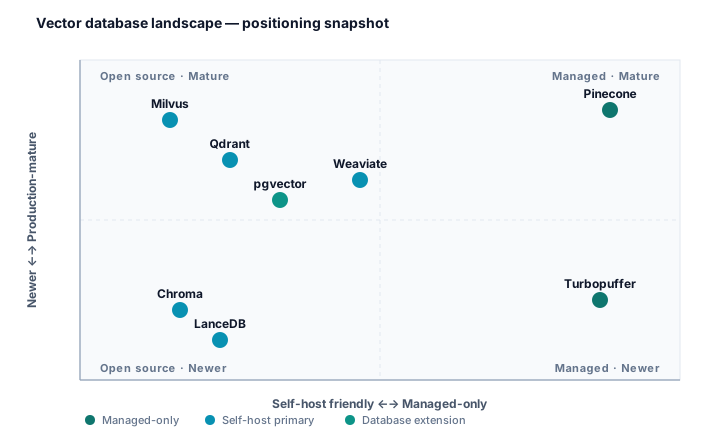
The vector database category has segmented into three operational tiers driven by where the workload sits and who is responsible for running the service. For most teams the right starting choice is the database-extension path — pgvector if Postgres is already in production — and to graduate to a dedicated vector store only when query latency, scale, or hybrid-search requirements exceed what the extension can support.
- Fully managed proprietary services (Pinecone, Turbopuffer) — fastest time-to-production, predictable performance, vendor lock-in.
- Open-source-with-cloud services (Weaviate, Qdrant, Chroma, Milvus, LanceDB) — flexibility to self-host or use the managed option, broader feature breadth, varying operational maturity.
- Database extensions (pgvector for Postgres, MongoDB Atlas Vector Search, Elasticsearch / OpenSearch vector search) — no new infrastructure, simplest integration path when an existing operational database already handles application data.
Domain Overview
The vector database category emerged as embedding models from OpenAI, Cohere, and the open-source ecosystem made it practical to build retrieval features without managing dense matrix infrastructure directly. The market has since compressed: pure-play vector databases now compete with established document stores (Elasticsearch, OpenSearch) and traditional databases (Postgres via pgvector, MongoDB via Atlas Vector Search), all of which have added vector search capabilities.
Three forces are shaping the next phase of the market:
- Hybrid search has won. Pure vector search is rarely the right primitive for production retrieval; users want vector similarity AND keyword filters AND metadata constraints in a single query. Every serious vendor now supports hybrid search.
- Workload distinction matters. A vector database serving an analytical workload (millions of vectors, batch queries, infrequent writes) has very different operational characteristics than one serving real-time RAG for a customer-facing chatbot. Vendors are starting to specialize for one or the other.
- Cost-per-query is the new battleground. Storage cost differences are small at typical workload sizes. The differentiator is query cost — particularly tail latency under load and pricing for high-throughput periods.
Category Breakdown
Fully Managed Proprietary
| Vendor | Status | Pricing Model | Strengths | Trade-offs |
|---|---|---|---|---|
| Pinecone | Production-mature | Per-pod or per-query | Production-stable, fast index builds, mature SDK ecosystem | Closed-source; pricing scales aggressively at high QPS; no self-hosting story |
| Turbopuffer | Newer | Per-namespace + per-query | Object-storage backed, dramatically lower cost at moderate scale | Smaller community, fewer integrations, production readiness varies by workload |
When to choose this tier: A team with no in-house infrastructure expertise that wants to ship the application and not the database, where the workload is well-scoped and the per-query cost is predictable.
Open Source + Managed Cloud
| Vendor | Status | License | Hosted Option | Notable Differentiator |
|---|---|---|---|---|
| Weaviate | Production-mature | BSD-3 | Weaviate Cloud Services | Schema-first design; built-in embedding-provider modules |
| Qdrant | Production-mature | Apache 2.0 | Qdrant Cloud | Rust implementation; strong benchmarks; rich filtering DSL |
| Milvus | Production-mature | Apache 2.0 | Zilliz Cloud | LF AI & Data Foundation governance; validated at very large vector counts |
| Chroma | Newer | Apache 2.0 | Chroma Cloud | Python-native DX; minimal-config local development |
| LanceDB | Newer | Apache 2.0 | LanceDB Cloud | Columnar storage; friendly to analytics-style access patterns |
When to choose this tier: A team comfortable with operational responsibility for a stateful service, with strong opinions about vendor lock-in, or with a use case where the cloud offering serves the immediate need with a clear migration path to self-hosted as scale or compliance demands.
Database Extensions
| Approach | Status | Best For | Strengths | Trade-offs |
|---|---|---|---|---|
| pgvector | Production-mature | Teams already on Postgres | Zero new infrastructure; ACID guarantees; SQL filtering on hybrid queries | Performance ceiling on dense workloads; index build time grows with corpus |
| MongoDB Atlas Vector Search | Atlas-only | Teams on MongoDB Atlas | Native integration with existing document model | Atlas-only; pricing tied to overall Atlas spend |
| Elasticsearch / OpenSearch | Search-first | Teams on existing OSS search platforms | Established operational tooling; mature query DSL | Vector search is a feature, not the focus |
When to choose this tier: When an existing operational database is already in production and the vector workload is moderate (typically under 10–50M vectors with secondary-priority query latency). Reduces cognitive load and operational footprint substantially.
Positioning: Specialized vs Integrated
Specialized vector stores
Best when retrieval IS the product
Pinecone, Weaviate, Qdrant, Milvus, Chroma, LanceDB, Turbopuffer
Integrated extensions
Best when retrieval supports a product
pgvector, MongoDB Atlas Vector Search, Elasticsearch / OpenSearch
White Space and Open Opportunities
- Hybrid relational + vector workloads at scale. Teams running operational Postgres with substantial vector workloads (50M+ vectors) face a forced choice: scale pgvector beyond comfort, or run a parallel vector store and synchronize. No vendor has a clean answer for keeping a single store for both.
- Multi-tenant vector isolation. Vendors serving B2B SaaS platforms with tenant-isolated vector indexes pay a steep operational price; most platforms were designed for a single large shared index.
- Compliance-grade hosting outside US-East. Several open-source-cloud vendors lack mature options for EU and Asia-Pacific data residency at meaningful service levels.
- Workload analytics over the vector index itself. Observability for query patterns, embedding drift, and retrieval quality across the vector store is still an artisanal layer most teams build themselves.
Risks and Open Questions for the Evaluator
Query distribution
Pricing differences are large at the tail. A workload with sustained high QPS and small per-query payloads will be expensive on per-query pricing models and cheaper on per-pod models. The reverse is true for spiky workloads with long idle periods.
What scale actually means
Sizing on vector count alone underestimates the actual cost. Embedding dimensionality, metadata richness, and concurrent index count all materially affect both storage and query cost.
Where the metadata lives
If most application metadata sits in an operational database that already has authoritative joins, keeping the vectors in pgvector beside that metadata is often the lowest-friction choice, even at the cost of some query latency.
Migration risk
Open-source-backed services give the cleanest path out if the choice is wrong. Fully managed proprietary services trade portability for operational simplicity — that trade is usually fine until it isn't.
Recommended Evaluation Sequence
- Quantify the workload first. Vector count, dimensionality, peak QPS, latency target (p50 and p99), expected concurrent index count, and metadata schema. Without these, vendor pricing comparisons are speculation.
- Decide on operational posture before evaluating vendors. If the team will not operate a stateful service, the choice is among managed-only offerings. If self-hosting is on the table, the calculus changes substantially.
- Prototype against two candidates from different tiers. Pair (pgvector + Pinecone) or (Weaviate self-hosted + Qdrant Cloud) covers enough of the design space to surface the real tradeoffs.
- Run a load test that mirrors production query distribution. Synthetic benchmarks consistently mislead because they don't capture the metadata-filter cost, which dominates real-world query latency in many workloads.
Sources
- Pinecone, Weaviate, Qdrant, Chroma, Milvus, LanceDB public product documentation and pricing pages.
- CNCF and LF AI & Data Foundation public project metadata for governance and adoption signals.
- Independent benchmarks at ann-benchmarks.com and vectorDBbench.
- Conference talks at QCon, KubeCon, and AWS re:Invent on production deployments.
- Postgres extension documentation for pgvector, MongoDB Atlas Search documentation, Elastic and OpenSearch vector search reference docs.
This sample illustrates the skill's output format. Analysis is based on publicly available information; ClearPoint Nexus is not affiliated with the companies named.
View full sample →
All sales final. No refunds on digital products.
Includes support for Claude Code, Codex, OpenClaw, and Google Antigravity in the same license.
Also in Market & Tech Intel
Bundle price: $55. Compare this skill with the full workflow bundle or Pro access.
Best for
Product leaders, strategy consultants, and operators making a vendor consolidation, market-entry, or category-evaluation decision who need a structured map of an unfamiliar domain in hours instead of weeks. Most useful when the deliverable will be reviewed by a non-specialist exec who needs categories and positioning more than line-item vendor specs.
Not ideal for
Deep technical evaluations of a single product’s architecture or feature parity — this maps the field, it does not benchmark vendors against each other. Also a poor fit for fast-moving consumer markets where positioning changes weekly; the structured artifact will go stale faster than the work to produce it.
Included in this purchase
- Claude Code, Codex, OpenClaw, and Google Antigravity skill files.
- Setup guidance for the right adapter in your workspace.
- One-time license for the purchased skill version.
Setup
Plan for a short copy-and-configure setup in your preferred agent workspace. No custom integration is required for the skill file itself.
Related Skills
$19.99
One-time license
$19.99
One-time license
$19.99
One-time license
Future Updates
This purchase includes the current version of the skill. If you want future adapter updates — meaning compatibility and packaging updates as supported platforms evolve — plus new catalog additions included automatically, upgrade to Pro.